
When a chikungunya outbreak strikes, who is the first to pinpoint the virus behind it?
When Ebola devastates parts of Africa, who is “up close and personal” with it inside the lab?
The answer is hidden inside a kind of special fortress—one as secure as a bank vault: the biosafety laboratory.
Today, let’s lift the veil on these invisible guardians and see how they use science to build a line of defense for life.
Labs have “safety levels” too? From kindergarten to special forces!
You may not know this, but labs also come in “levels,” just like leveling up in a game—the higher the hazard, the more advanced the gear.
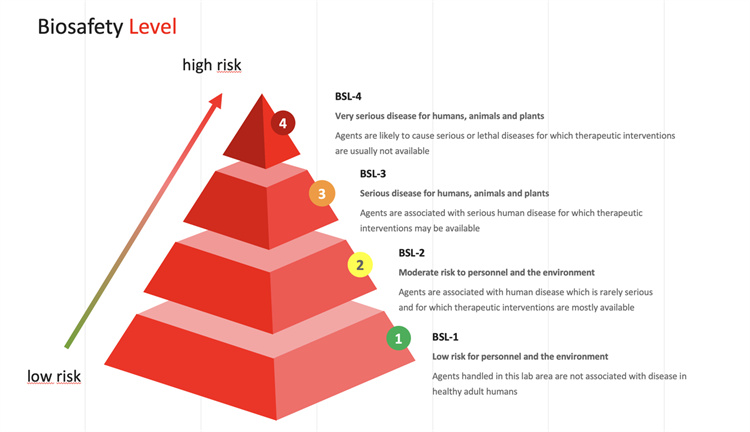
Based on the protective measures used for pathogenic microorganisms, laboratories are divided into four levels (BSL-1 to BSL-4).
BSL-1: The lab world’s “kindergarten”
What they study: Microorganisms that do not cause disease in humans or animals—harmless “good kids,” like the lactic acid bacteria used to make yogurt.
Protection level: Lab coat + gloves, basically the same standard as good kitchen hygiene.
Where you’ve seen it: The lab that runs your routine medical tests is often this level.
BSL-2: A “sentinel station” for community health
What they study: Microbes that can make humans or animals sick, but symptoms are usually mild and rarely fatal—like influenza viruses and Salmonella.
In other words, “manageable troublemakers”: they can cause illness, but they’re not unstoppable, and we do have ways to control them.
Protection level: Upgraded! Requires biosafety cabinets, autoclaves, and medical protective equipment.
Where you’ve seen it: Many hospital labs and CDC-style public health labs fall into this category.
BSL-3: The “command center” for high-risk pathogens
What they study: Microbes that can cause severe or even fatal disease—serious “boss-level” threats like SARS-CoV-2, Mycobacterium tuberculosis, and highly pathogenic avian influenza viruses.
Protection level: Full-scale upgrade!
-
a. A negative-pressure “prison”: The air pressure inside stays lower than outside (about -30 Pa), so air flows only from the clean corridor into the lab. Air inside the lab—possibly carrying pathogen aerosols—cannot flow back out. The escape route is sealed off completely.
-
b. Double-filter “purification net”: Exhaust air must pass through HEPA filters, blocking 99.97% of viruses and bacteria—particles as small as 0.3 microns don’t get through.
-
c. Fully geared up: Lab staff become “full PPE pros,” wearing coveralls + N95 respirators + face shields.
What makes it powerful: A BSL-3 lab is like a “scientific prison” built specifically to contain and study dangerous pathogens—highly harmful and highly transmissible, but here, they cannot break out.
BSL-4: The ultimate fortress of biosafety
What they study: Extremely dangerous microbes—fast-spreading, hard to treat, and sometimes with no established cure—like Ebola virus and smallpox virus.
Protection level: The ceiling. The absolute top tier.
-
a. Sealed capsule: The lab is like an independent space module, completely isolated from the outside world.
-
b. Life-support system: Researchers wear “space suits” with their own air supply—so even if something is damaged, they won’t inhale outside air.
How rare is it: Only a handful nationwide—truly the “strategic weapon” of public health.
Five layers of defense: pathogens can’t escape—even with wings!
Worried about a lab leak? This protection system is tighter than a bank vault—a scientific version of an iron wall.
Protection layer — Core measures — What it’s like
-
a. Building defense: Special stainless-steel walls + seamless flooring — like bulletproof armor
-
b. Equipment defense: Biosafety cabinets (capture 99.97% pathogens), autoclaves (sterilize at 121°C) — a “super-range hood” + an “incinerator”
-
c. Process defense: Standardized workflows for entry/exit, equipment use, and procedures — a precision assembly line
-
d. People defense: Three-stage qualification (theory + simulation + drills), regular health monitoring + vaccination — a special forces training camp
-
e. Smart defense: Airlock interlock doors (two doors can’t open at once), 24/7 environmental monitoring and alerts — sci-fi-grade access control
Common misunderstandings about labs…
Misunderstanding 1: More labs = more danger.
Professional labs actually make high-risk work safer—like how fever clinics help outbreaks stay controlled.
Misunderstanding 2: Higher level = easier to leak.
The opposite. BSL-4 labs have been operating globally for more than 60 years, with only three reported accidents worldwide (all due to human operational error). China has maintained a 10-year zero-accident record.
Misunderstanding 3: This has nothing to do with regular people.
Childhood vaccines, annual flu surveillance, food safety testing… these labs quietly protect every link in daily life.
Post time: Jan-20-2026


